¿Que hacer si los teléfonos no funcionan?
Usamos la Comunicación Portatil que hemos Almacenado
Planeen por Adelantado sus Medicamentos para tener lo necesario Durante un Desastre
What If Phones Don’t Work?
Portable Communications Caches
At neighborhood preparedness meetings, folks sometimes ask us, “how would islanders communicate in a disaster if cell and landline phones stopped working?” One important solution is amateur (ham) radio.
On Saturday December 6th, you may have seen volunteers gathered under the shelter at the Village Green. Leaders from Vashon’s Auxiliary Communications Service (ACS), a committee of the Vashon-Maury Island Radio Club (VMIRC), were training Community Emergency Response Team (CERT) volunteers how to use the latest versions of ACS’s Portable Communications Caches (PCCs).
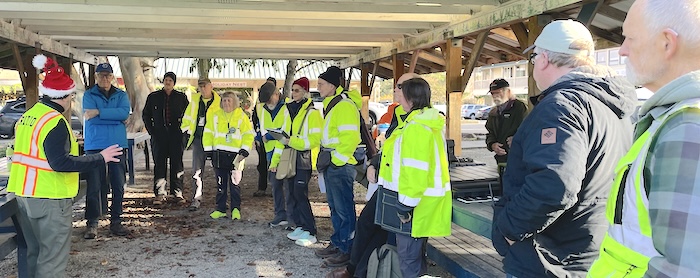
Some of the 18 volunteers who attended training on the Portable Communications Caches. Photo by Vicky de Monterey Richoux
The ACS team has developed three PCCs, each containing two ham radios, a laptop computer, and all the accessories needed to set up regional voice and email emergency communications via radio at distributed locations around the island. A fourth PCC contains a high-frequency (HF) radio for longer-range “over the horizon” communications, if needed.
Better than IKEA: Detailed instructions are included in each PCC. This is critical because thinking clearly may be tougher immediately after a disaster strikes. Picture-based instructions help someone inexperienced still successfully set up and use the PCC. By law, however, only people with an FCC license granting an amateur radio call sign are allowed to transmit messages via ham radio.
Lessons learned from the September Medical Reserve Corps (MRC) exercise at Sunrise Ridge informed the training and led to enhancements of the caches. The PCCs have been named after the Sesame Street characters Elmo, Bert, Ernie, and Big Bird, as a lighthearted way to distinguish the caches as they travel around the island. To learn more about ham radio and get involved, visit tinyurl.com/VashonACS
Plan Ahead for Your Prescriptions During a Disaster
For cost savings, convenience, and at the urging of their insurance plans, lots of people mail-order their prescription drugs in 90-day supplies. But a big earthquake, a winter storm, or any other disruption of U.S. mail deliveries could cause your mail-ordered insulin, heart medicine, or other critical medical supplies to be delayed. Here’s what you can do right now, before any future disaster, if you or family members rely on one or more essential prescriptions:
–Document your medication details: drug name and dose, prescription number, name of your doctor and pharmacy. Keep a list in your wallet (or on a mobile app that tracks medications), along with your updated health information, contact information for your doctors, pharmacist, and other emergency contacts. This information can help you get emergency refills from a pharmacy near your current location, if you find yourself away from home or your mail-ordered prescription is delayed after a disaster strikes. (Remember to include at least a few days’ worth of essential medications in your go bag.) According to Tyler Young, owner of Vashon Pharmacy, state laws often allow pharmacies to issue refills during a disaster declaration, even after all your refills have been used up.
–Develop an extra supply that can tide you over during an emergency: request a “vacation supply”, or refill prescriptions as soon as insurance allows (usually five to seven days before you would run out).
–Consider filling prescriptions locally. Because using mainland pharmacies poses extra cost and time burdens, our insurance plans are more likely to allow local, in-person filling of prescriptions. The biggest benefit is that Vashon Pharmacy would have up-to-date records of your critical medications. Tyler Young added, “After a disaster, it would be very easy to help current patients of Vashon Pharmacy, and much harder but still possible to help patients who didn’t already get their prescriptions at Vashon Pharmacy. Having awareness of medication needs at the community level allows the pharmacy to tailor its inventory to be better able to provide refills after an emergency.”
-Another reason to fill prescriptions locally is to get advice about medications that require refrigeration. Keep a small cooler handy, with ice packs or a frozen plastic water bottle in the freezer, to be ready in case of a power outage. Some medications may be fine at room temperature for a few days; the pharmacist can help you determine if that’s the case. Insulin, for example, can go without refrigeration and be kept at a temperature between 59°F and 86°F for as long as 28 days, per the U.S. Food and Drug Administration (FDA).
–Consider refilling your prescriptions for 90 days at a time, if your insurance allows it or if you pay cash for your prescriptions. This saves money over 30-day refills because part of the cost of each prescription refill is the service fee to fill it. Most insurance, including Medicare, will allow 90-day refills for most medications. To make the switch, you may need a new 90-day prescription from your provider. Speak with your healthcare provider or pharmacist if you need help.
–For individuals without insurance, the Emergency Prescription Assistance Program (EPAP) provides free emergency medication refills during federally declared disasters. You can call the program’s hotline at (855) 793-7470 to find out if you’re eligible. Learn more at tinyurl.com/EmergencyRefills
Noticias de VashonBePrepared
Jueves, 18 de diciembre de 2025
¿Que hacer si los teléfonos no funcionan? Usamos la Comunicación Portátil que hemos Almacenado
En las reuniones que se han llevado a cabo para estar prepardos, los participantes nos han preguntado, ‘¿como se comunicarían los isleños durante un desastre si los teléfonos celulares y fijos dejaran de funcionar?’ Bueno, una buena solución son los radioaficionados.
El sábado 6 de diciembre, quizas algunos de ustedes vieron varios de los voluntarios reunidos bajo el refugio o resguardo del Village Green. Los líderes del Servico de Comunicaciones Auxiliares de Vashon o ACS por sus siglas en inglés, que es un comité del Radio club de las islas de Vashon y Maury (VMIRC), estaban entrenando a los voluntarios del CERT o Equipo de Respuesta a Emergencias Comunitarias, sobre cómo usar las últimas versiones de los PCCs o cachés portátiles de comunicaciones.
Algunos de los 18 voluntarios que participaron en el entrenamiento para el uso de los cachés portátiles de comunicaciones. Foto de Vicky de Monterey Richoux.
El equipo del ACS ha desarrollado tres PCCs, donde cada uno contiene dos radioaficionados, una computadora laptop, y todos los accesorios necesiarios para establecer comunicaciones de emergencia usando el radio en la región, tanto de manera oral como por correo electronico, usando los radios que se han distribuido en diferentes sitios alrededor de la isla. Un cuarto PCC, contiene un radio de alta frecuencia (HF) para cuando sea necesario un mayor alcance.
Mejor que IKEA: En cada PCC se incluyen instrucciones detalladas. Esto es crítico porque el pensar de manera clara puede ser difícil despues de que ocurre un desastre. Instrucciones con fotografías, ayudan a varios de los que tienen menos experiencia para que puedan instalar y usar el PCC. Por ley, solo las personas con una licencia del FCC que le da a un radioaficionado que es principiante, permiso para transmitir mensajes a traves del radio.
Las lecciones que se aprendieron en el ejercicio que el Cuerpo de Reservas Medicas o MRC tuvo en Sunrise Ridge en septiembre, pasaron a ser parte de este entrenamiento. A los PCCs se les ha llamado Elmo, Bert, Ernie y BigBird, usando los nombres de Sesame Street, con la idea de distinguir los diferentes caches en la medida que viajan por la isla. Para aprender mas sobre la radioafición e involucrarse, visite el siguiente enlace: tinyurl.com/VashonACS.
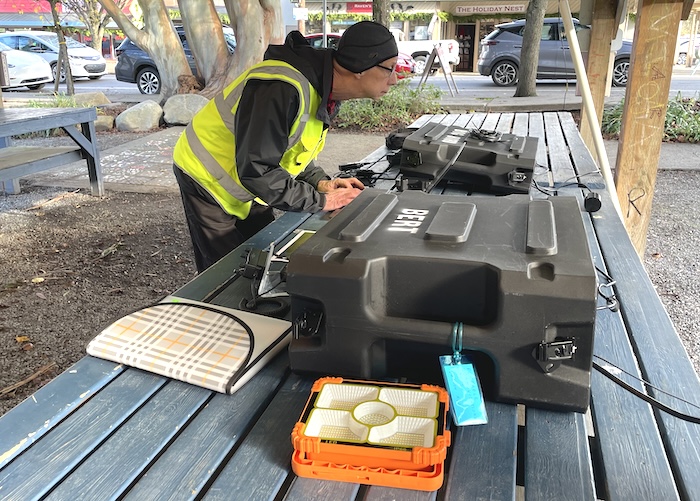
| John Galus trabaja con el PCC Big Bird para subir los listados de canales mas recientes al radio de uno de los voluntarios. Foto de Vicky de Monterey Richoux |
Planeen por Adelantado sus Medicamentos para tener lo necesario Durante un Desastre.Para ahorrar en el costo, por conveniencia, y dependiendo del plan que cada quien tiene, mucha gente ordena sus medicamentos por correo en suministros de 90 dias. Pero un gran terremoto o temblor, una tormenta invernal o cualquier otro evento, que altere la entrega a traves del correo, puede causar que su insulina, sus medicinas del corazón o cualquier otro medicamento crítico para su salud, se retrace o no llegue a su destino. Asi que aquí está algo de lo que usted o algun otro miembro de la familia pueden hacer, si dependen de un o más medicamentos con receta:
|