Lessons From the 2001 Nisqually Earthquake
Practice Earthquake Readiness: ShakeOut Day is Oct. 15
VIFR Adds More CPR Classes
CORRECTION: Community Van
Lecciones del Terremoto del 2001 en Nisqually
Practiquemos como estar Preparados para un Terremoto:
El dia del ShakeOut es el 15 de octubre
(este dia se celebra en todo el mundo el simulacro de un terremoto)
VIFR Agrega mas Clases de CPR
CORRECCIÓN: Vagoneta Comunitaria
Lessons from the 2001 Nisqually Earthquake
Do You Remember? Twenty-five years ago, the Nisqually earthquake struck our region. At 10:54 a.m. on February 28, 2001, the magnitude 6.8 earthquake shook our homes, offices, schools, and regional infrastructure for 30-40 seconds. It also triggered landslides and liquefaction. The earthquake injured about 400 people and caused one death. Total damages were estimated to be $2-4 billion. Almost 300,000 residences in the Puget Sound area were damaged (tinyurl.com/EQdamagePS). Things could have been far worse: improved building codes and personal and institutional preparedness made a difference. (tinyurl.com/NisquallyEQ).
The Kids Are Alright: Retired Vashon High School teacher Tom DeVries recalled being in class when the earthquake hit. “The students were under their desks in seconds. It was impressive how they knew instinctively what to do, because of earthquake drills over the years.”
The students had rehearsed many times that when you feel an earthquake, you should immediately DROP to your hands and knees, COVER your head and neck under a sturdy table or desk, and HOLD ON to your shelter until shaking stops. If no shelter is nearby, you should crawl next to an interior wall, avoiding glass and falling objects.
What To Expect: We live in a seismically active area where a major earthquake could occur any time. According to the U.S. Geological Survey, there’s an 85% chance that in the next 50 years the Puget Sound region will experience another deep, Nisqually-type earthquake of magnitude 6.5 or greater (tinyurl.com/usgs2025). During the same period, the chance is 10-15% for a magnitude 9 Cascadia Subduction Zone earthquake and 17% for a magnitude 6.5 or greater shallow crustal fault earthquake. The Seattle and Tacoma Fault Zones are nearby areas of crustal faults.
How to Get Ready: The size and timing of earthquakes can’t be predicted, but you can prepare by making your home safer in multiple ways. For example, if you live in an older house, make sure the framing is bolted to the foundation. A builder or structural engineer can check that for you. Inside your home, don’t hang heavy or breakable objects over beds, and secure tall bookcases and hot water tanks to wall studs. For additional tips, see tinyurl.com/EQhomeSafety
Being prepared for a large earthquake that could turn into a regional disaster also means being ready to be self-sufficient for up to three weeks. Store extra food, water, and prescription medications for your household, keep a “go bag” ready, have a household reunification plan, and keep a battery-powered radio handy for public announcements. For more details, see vashonbeprepared.org/prepare-household
Finally, consider putting the MyShake app on your phone to receive Earthquake Early Warning Alerts. Find it for Apple or Android at myshake.berkeley.edu. These alerts may provide valuable seconds of advance notice that the ground at your location is about to start shaking following an earthquake in the region. Those extra seconds give you more time to find a safe spot to DROP! COVER! and HOLD ON!
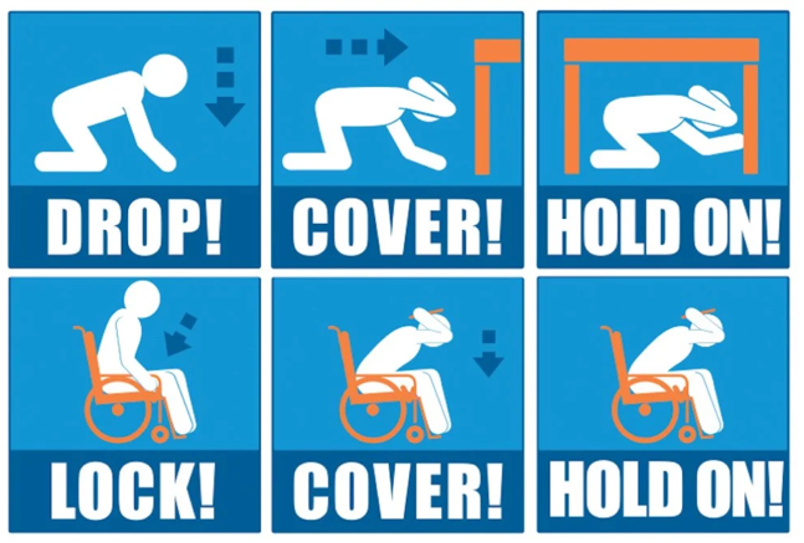
(Various infographics remind us how to respond safely when the earth shakes. The upper section pictures a human figure as they drop, cover, and hold on. The lower section describes what a person in a wheelchair should do: lock, cover their head with their hands, and hold on. For what to do in more situations, visit shakeout.org)
Practice Earthquake Readiness: ShakeOut Day is October 15
Earthquakes can happen at any time of year, so don’t wait to mark your calendar for every year on October 15th at 10:15am local time, when people in earthquake-susceptible regions around the world participate in International ShakeOut Day. Practicing what we’ll do if an earthquake strikes helps us develop muscle memory, and remain calmer than if we hadn’t practiced. You can join in wherever you are, to be more mentally and physically prepared for when the earth shakes. Mark your calendar now, and we’ll remind you again when the date gets closer. Visit shakeout.org or www.shakeout.org/espanol for more information, and tips for how everyone can participate.
VIFR Adds More CPR Classes
In addition to the March 11th class, Vashon Island Fire & Rescue has announced two additional free CPR classes, on the evenings of April 22nd and May 7th. These classes fill quickly – learn more and register at vifr.org/cpr-classes.
CORRECTION: Community Van
We included inaccurate text in our previous newsletter about getting to medical appointments. Below is the corrected text. We apologize for any confusion this may have caused.
Another option is Community Van, a King County Metro program offering a flexible way to share rides for groups of 2–11 riders, plus an approved volunteer driver. Trip requests must be made at least two business days in advance and are filled on a first-come, first-served basis. Each trip requires an approved volunteer driver and two or more riders. Participants are encouraged to invite eligible family, friends, neighbors, or caregivers to become approved drivers.
Riders pay a standard Metro bus fare; drivers ride free, and the Community Van and driver sail free for off-island trips returning via Fauntleroy and Point Defiance. King County Metro provides the van, fuel, and insurance. Accessible vans are available upon request.
To request a trip or learn how to become an approved volunteer driver for a loved one, friend, or your community, visit tinyurl.com/VashonVan or the King County Community Van webpage. You may also email communityvan@vashonchamber.com
Approved volunteer drivers must meet program requirements and complete the King County Metro Community Van driver approval process, which includes an application, in-person training, and an online orientation. For more information, visit the King County Community Van webpage.
Noticias de VashonBePrepared
Lecciones del Terremoto del 2001 en Nisqually
¿Se Acuerdan? Hace veinticinco años el terremoto o temblor de Nisqually azotó nuestra región. A las 10:54 de la mañana, del 28 de feberero de 2001, un terremoto de magnitud 6.8 sacudió nuestras casas, oficinas, escuelas e infraestructura regional por 30 a 40 segundos. Tambien ocasionó deslaves y licuefacción. El temblor lesionó a 400 personas y resultó en un fallecimiento. Los daños totales se calcularon en 2 a 4 millones de millones. Casi 300,000 residencias en el Puget Sound, se vieron afectadas (tinyurl.com/EQdamagePS). Las cosas pudieron haber sido mucho más serias: quizás lo que hizo la mayor diferencia fue la mejoria en los codigos de construcción y el estar preparados, tanto a nivel personal como institucional (tinyurl.com/NisquallyEQ).
Los Chicos y Chicas, Están Todos Bien: Tom DeVries, maestro jubilado de la escuela preparatoria de Vashon, recuerda haber estado en clase cuando ocurrió el temblor. “Los estudiantes estaban abajo de sus escritorios en segundos. ‘Fue impresionante ver, como, de manera instinctiva supieron que hacer, esto, gracias a todos los años en los que practicamos simulacros de terremotos.’
Los estudiantes habian practicado muchas veces, y sabian que cuando sintieran un temblor, de inmediato habria que AGACHARSE sobre manos y rodillas, CUBRIRSE la cabeza y cuello abajo de una mesa o escritorio, y AGARRARSE a las patas hasta que paren las sacudidas. Si no hay mesas o escritorios cerca, entonces hay que acercarse a una pared interior, con la idea de evitar el vidrio de las ventanas y objetos que se pueden caer.
¿Que Esperar?: Vivmos en un área sísmica activa donde un importatne terremoto puede ocurrir en cualquier momento. De acuerdo con el Servicio Geológico de EEUU, hay un 85% de probabilidad de que en los próxmos 50 años, la región del Puget Sound tenga otra experiencia muy similar, a la de Nisqually, con un terremoto de una magnitus de 6.5 o mayor. (tinyurl.com/usgs2025). Durante el mismo periodo, hay una probabilidad del 10 al 15% para un temblor de magnitud 9 en la zona de Subducción de Cascadia y un 17% para un temblo de magnitud 6.5 o mayor para un sismo superficial de la falla cortical. Las zonas de las Fallas de Tacoma y Seattle estan cerca del area de las fallas corticales.
Como Estar Listo: La magnitud y el momento en que tendremos un temblor, no se pueden predecir, pero usted puede estar bien preparado, haciendo más seguras una serie de cosas en su casa. Por ejemplo, si usteed vive en una casa vieja, asegúrese que el marco esta bien atornillado a la fundación o base de la casa. Alguien que trabaje en construcción o sea un ingeniero estructural, puede revisar que este sea el caso. Dentro de la casa, no cuelgue objetos pesados o que se puedan romper, encima de las camas y asegurese que todos los libreros altos que tenga, asi como el calentador de agua, estan sujetos a los montantes de pared. Para mas información, vea: tinyurl.com/EQhomeSafety.
Estar preparado para un terremoto grande que se puede convertir en un desastre regional, tambien significa estar preparado para ser autosuficiente por lo menos por tres semanas. Almacene comida extra, agua, y medicamentos, y no se le olvide mantener una ‘bolsa con lo esencial’, tenga un plan de reunificación si por alguna razón se separan, y mantenga un radio de baterias cerca de usted, para escuchar los anuncios publicos. Para mas detalles de como estar preparados, viste: vashonbeprepared.org/prepare-household.
Finalmente, considere poner el app de MyShake en su teléfono, para recibir Alertas Tempranas de Temblores o Terremotos. Lo puede encontrar para Apple o Androide en myshake.berkeley.edu. Estas alertas pueden proveer importante información unos segundos antes de que la tierra en el area en la que está, empiece a sacudirse, como resultado de un terremoto en la región. Esos extra segundos, le dan tiempo para encontrar un lugar seguro para ¡AGACHARSE!, ¡CUBRIRSE! Y ¡AGARRARSE!
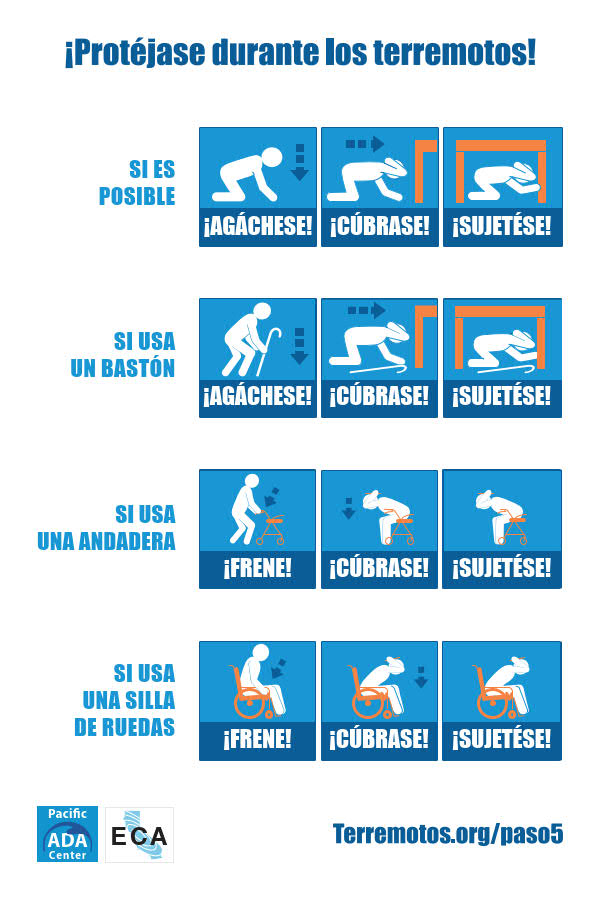 (Varias infográficas nos recuerdan sobre como responder de una manera segura cuando la tierra tiembla. La seccion superior de la figura, muestra a una persona agachandose, cubriendose y agarrandose. La seccion inferior describe el caso de lo que haria una persona en una silla de ruedas: Ponga el freno, cubrase la cabeza con los manos y brazos, y sujetese. Para mas información, use: shakeout.org/espanol)
Practiquemos como estar Preparados para un Terremoto:
Los terremotos pueden ocurrir en cualquier momento, asi que por favor no se espere a marcar su calendario cada año, para el 15 de octubre a las 10:15 am hora local, cuando las personas en regiones susceptibles a temblores, participan en el día Internacional del ShakeOut. Practicar con frecuencia nos ayuda a lo que haremos cuando haya un terremoto es lo que desarrolla esta memoria muscular, y conservar la calma en comparacion con el no haber parcticado. Usted se puede agregar a un grupo en donde se encuentre, para estar mentalmente y fisicamente preparado, para cuando se sacuda la tierra. Marque su calendario ahora, y nosotros le recordaremos cuando la fecha se acerque. Visite para obtener mas información www.shakeout.org/espanol ysugerencias en como participar.
VIFR Agrega mas Clases de CPR
Agregado a las clases del 11 de marzo, VIFR acaba de anunciar que agregaran otras dos clases de CPR, en abril 22 y mayo 7. Estas clases se llenan muy pronto, asi que si usted tiene interes por favor regsitrese en: vifr.org/cpr-classes.
CORRECCION: Vagoneta Comunitaria
En el boletín anterior, pusimos información incorrecta sobre como llegar a sus citas médicas. Aqui esta el texto correcto y nos disculpamos por cualquier confusion que esto haya podiod causar.
Otra opción es la Vagoneta Comunitaria, que es parte del programa Metro del condado King, que ofrece una manera flexible de compartir viajes con grupos de 2 a 11 viajeros, agregado a un chofer autorizado. Los viajes se tienen que pedir por lo menos 2 dias hábiles por adelantado y los servicios se ofrecen en el orden en que van llegando. Cada viaje requiere de un chofer autorizado y dos o más viajeros. Se les sugiere a los participantes que inviten a familiares, amigos, vecinos o cuidadores, a que se animen a ser choferes autorizados.
Los viajeros pagan la trifa estandar del Metro bus; los choferes viajan gratis, y la vagoneta comunitaria y el chofer viajan gratis para viajes fuera de la isla al margen de que regresen por Fauntleroy o por Point Defiance. Metro del condado King, provee la vagoneta, la gasolina, y el seguro o aseguranza. Las vagonetas estan disponibles bajo petición o sea cuando usted la pida.
Para pedir un viaje o aprender como se puede ser un voluntario aprobado para manejar a algun ser querido, un amigo o alguien en su comunidad, por favor visite: tinyurl.com/VashonVan o el sitio,en la red de King County Community Van. Trambien puede enviar un correo: communityvan@vashonchamber.com
Los voluntarios interesados en ser voluntarios aprobados, tienen que terminar el programa que Metro del condado King tiene para ser chofer. Esto incluye llenar solicitud, hacer el entrenamiento en persona, y tomar el curso de orientación en linea. Para obtener mas información, visite el sitio en la red: King County Community Van.